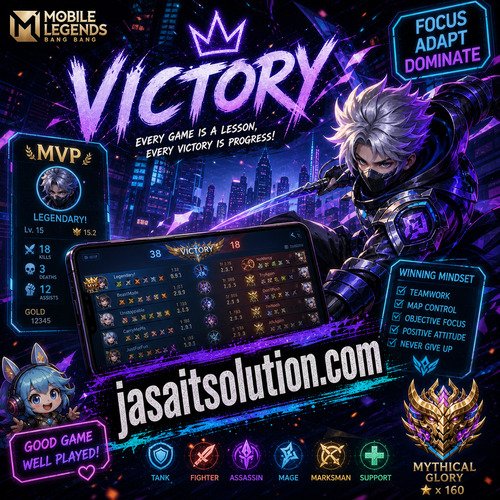
jasaitsolution.com – Mobile Legends: Bang Bang has become one of the most recognizable multiplayer online battle arena games because it combines fast-paced action, strategic decision-making, and teamwork in a competitive environment. Every match challenges players to understand their heroes, control the battlefield, cooperate with teammates, and make the right decisions under pressure. Although the basic objective is straightforward, destroying the enemy team’s base requires much more than defeating opponents in individual battles. Players must understand how different roles function, when to attack, how to defend important areas, and why controlling objectives can be more valuable than collecting eliminations.
For beginners, the game can initially feel overwhelming because every hero has different abilities, strengths, and weaknesses. Experienced players also face challenges when opponents change their strategies, protect important objectives, or exploit mistakes during team fights. Improving consistently therefore requires a combination of mechanical skill, map awareness, resource management, and tactical understanding. Learning how these elements work together allows players to become more reliable teammates while making better use of their chosen heroes.
Understanding Core Gameplay and Developing Strong Fundamentals
The foundation of Mobile Legends is understanding the battlefield and recognizing how each action contributes to the team’s overall progress. A standard match takes place on a map divided into three lanes: the gold lane, the experience lane, and the middle lane. Each lane contains defensive turrets that protect the path toward the enemy base. Between these lanes lies the jungle, where neutral monsters provide additional gold, experience, and valuable temporary advantages. Players must gradually weaken the opposing defenses while protecting their own structures, creating opportunities to reach and destroy the enemy base.
At the beginning of a match, minion waves move automatically along the lanes and engage opposing waves near enemy defenses. Defeating these minions provides resources that help heroes purchase equipment and unlock stronger abilities. Although minions may appear unimportant compared with enemy heroes, they influence nearly every stage of the game. Clearing a wave quickly can create time to rotate toward another lane, assist a teammate, invade the enemy jungle, or prepare for a major objective. Conversely, ignoring a large wave may allow the opponent to damage a turret or collect resources without facing resistance.
Turrets deserve particular attention because they control access to different parts of the map. Destroying an outer turret opens additional movement opportunities and makes it easier to pressure enemy territory. However, attacking a turret without considering the enemy’s position can expose a player to an ambush. Before approaching a structure, examine the minimap, determine which opponents are visible, and consider whether nearby teammates can provide support. A successful push often depends on timing rather than raw damage.
Neutral objectives also influence the direction of a match. The Turtle can provide valuable rewards that strengthen a team during the early stages, while the Lord can help create pressure against enemy defenses later in the game. Fighting for these objectives without preparing the surrounding area can be dangerous. Players should clear nearby minion waves, check enemy movements, and coordinate their approach before committing to a contest.
Understanding the relationship between lanes, turrets, minions, jungle monsters, and neutral objectives helps players recognize that Mobile Legends is not simply a sequence of fights. Every successful decision should contribute to gaining resources, creating map pressure, protecting teammates, or moving closer to the enemy base.
Choosing the Right Hero and Understanding Each Role
Hero selection plays an important role in determining how a team approaches a match. Mobile Legends offers a broad selection of heroes with different abilities, attack ranges, defensive characteristics, and tactical purposes. Rather than choosing a character exclusively because of appearance or popularity, players should consider how that hero fits their preferred playstyle and the needs of the team.
Tanks generally provide durability and help absorb incoming damage. Their presence allows teammates to fight with greater confidence, especially when entering dangerous areas or defending important objectives. Fighters combine damage with survivability, making them useful in extended engagements and side-lane pressure. Assassins usually specialize in eliminating vulnerable targets through mobility, burst damage, and precise timing. They can influence a match significantly, but poor positioning may leave them exposed to crowd control or retaliation.
Mages contribute magical damage and often possess abilities that control areas, slow opponents, or interrupt enemy movement. Marksmen usually become increasingly important as they obtain equipment, delivering sustained damage during later stages of a match. Supports help maintain team effectiveness through healing, shielding, movement enhancements, or other forms of utility. Each role provides a different contribution, and a balanced team can respond to more situations than a lineup built around damage alone.
Beginners benefit from concentrating on a small group of accessible heroes rather than constantly switching characters. Repeated practice makes it easier to understand ability ranges, cooldowns, damage patterns, and favorable matchups. Once a player becomes comfortable with one role, learning another can improve their understanding of team composition and reveal what teammates need during combat.
Team composition should also be considered during hero selection. A lineup containing several fragile damage dealers may struggle against enemies who initiate fights aggressively. A team with limited ranged damage may have difficulty dealing with durable opponents, while a composition lacking crowd control can struggle to stop highly mobile enemies. Players do not need to construct a perfect lineup every time, but they should recognize potential weaknesses and adapt their decisions accordingly.
Ultimately, the best hero is not necessarily the one with the highest theoretical damage. A suitable hero is one whose abilities the player understands, whose role supports the team, and whose strengths can be used effectively against the opposing lineup.
Managing Gold, Experience, and Equipment Efficiently
Gold and experience determine how quickly heroes develop during a match. Gold allows players to purchase equipment, while experience unlocks stronger abilities and improves a hero’s overall effectiveness. Managing these resources efficiently can create a significant advantage even when both teams have similar numbers of eliminations.
One of the most important habits is collecting minion rewards consistently. Leaving a lane for too long without a clear purpose can cause a player to miss valuable resources. At the same time, remaining in a lane when a major team objective requires assistance may sacrifice a greater strategic opportunity. Good resource management means balancing immediate income against the potential value of helping teammates.
Equipment choices should reflect the situation rather than follow a fixed sequence without consideration. Offensive items can improve damage, attack speed, penetration, or ability effectiveness, depending on the hero. Defensive equipment can reduce incoming damage or provide additional protection against specific threats. Some matches require more physical defense because the enemy team relies heavily on physical attackers, while others demand stronger magical protection or tools that reduce the effectiveness of enemy healing.
Players should observe which opponents are becoming dangerous. If an enemy assassin repeatedly eliminates the backline, purchasing suitable defensive equipment and adjusting positioning may be more useful than adding another offensive item. If the enemy team depends on healing to survive extended fights, anti-healing equipment may improve the team’s ability to secure eliminations. These adjustments demonstrate that equipment is not simply a collection of statistics; it is a response to the evolving conditions of a match.
Junglers must manage their routes carefully because neutral monsters provide resources needed to develop their heroes. Roaming players also need to understand when assisting a lane is worthwhile and when traveling across the map wastes too much time. Meanwhile, side-lane players should avoid unnecessary fights that interrupt their resource collection without providing a meaningful advantage.
The central principle is efficiency. Every movement, ability, and purchase should have a purpose. Players who collect resources consistently, avoid unnecessary deaths, and purchase equipment suited to the match can become influential without needing to dominate every early encounter.
Developing Map Awareness and Better Rotations
Map awareness is one of the most valuable skills in Mobile Legends because the minimap provides information that cannot always be seen directly on the battlefield. By checking it frequently, players can track visible enemies, recognize potential threats, identify opportunities for assistance, and avoid moving into dangerous areas without support. Strong awareness often prevents mistakes before they happen.
For example, a marksman farming near an enemy turret may feel safe because no opponent is currently nearby. However, if several enemy heroes disappear from the minimap, the situation becomes more dangerous. They may be preparing an ambush, moving toward a neutral objective, or attempting to surround a teammate. Continuing to farm without adjusting positioning gives the enemy an opportunity to secure an easy elimination.
Rotations involve moving from one area of the map to another to support teammates or influence important objectives. A mid-lane mage might clear a minion wave before helping the gold lane, while a roamer may move through the river to establish vision and protect a jungler. These movements work best when they are coordinated with lane conditions. Arriving at a lane after the opponent has already retreated may waste time, whereas arriving immediately after an enemy uses an important ability can create a strong opportunity.
Players should also understand that rotating does not always mean abandoning their current responsibilities. A side-lane fighter may need to clear a large wave before joining a team fight, especially if leaving immediately would allow an enemy to destroy a turret. Similarly, a jungler should consider the location of neutral monsters and the timing of important abilities before committing to a distant skirmish.
Communication makes rotations more effective. Quick messages can warn teammates about missing opponents, announce an approaching objective, or indicate that a player needs assistance. Even without voice communication, consistent pings can help the team coordinate its movements.
Another important habit is recognizing when not to fight. If teammates are far away, abilities are unavailable, or the enemy has a numerical advantage, retreating may be the smartest decision. Players sometimes mistake aggression for skill, but successful rotations depend on identifying favorable situations rather than constantly searching for combat.
Over time, map awareness helps players predict what might happen next. Instead of reacting only after an enemy appears, they begin anticipating possible movements and positioning themselves to respond. This shift from reaction to prediction is an important step toward more consistent performance.
Executing Team Fights with Positioning and Timing
Team fights often determine the outcome of a Mobile Legends match, particularly when both teams have completed several important equipment purchases. However, winning these encounters does not depend exclusively on who deals the most damage. Positioning, target selection, ability timing, and coordination determine whether a team can use its advantages effectively.
Before engaging, players should evaluate the situation. Consider how many enemies are nearby, whether teammates are ready to participate, and whether important abilities are available. Starting a fight while the team’s primary damage dealers are far away can leave the frontline isolated. Likewise, initiating combat without knowing the enemy’s location may allow opponents to counterattack from an unexpected direction.
Tanks and fighters frequently help create opportunities by controlling enemy movement or disrupting the opposing formation. Their job is not always to secure eliminations personally. Sometimes the most valuable action is preventing an enemy assassin from reaching the marksman or forcing an opposing mage to reposition. These contributions can create enough space for the team’s damage dealers to operate safely.
Marksmen and mages generally need to pay close attention to positioning because they can become vulnerable when caught by crowd control or sudden burst damage. Remaining behind frontline teammates provides protection, but standing too far away can make it difficult to contribute. The goal is to maintain an effective distance where damage can be delivered without exposing the hero to unnecessary danger.
Target selection should also reflect the current situation. Eliminating a vulnerable enemy damage dealer can weaken the opposing team’s ability to continue fighting. However, chasing that target deep into enemy territory may be dangerous if several opponents remain nearby. Sometimes attacking the closest accessible threat is more effective than attempting to reach a protected backline.
Abilities should be used with intention. Spending every skill immediately may leave a hero unable to respond when the enemy initiates a counterattack. Crowd-control abilities can be especially valuable when combined with teammates’ damage, allowing the team to focus on a target before they escape. Defensive abilities should not be ignored simply because offensive opportunities appear attractive.
After winning a team fight, players should convert the advantage into something meaningful. Depending on the situation, the team might secure the Lord, destroy a turret, invade the enemy jungle, or push a lane. Continuing to chase opponents after the fight has already been won can waste valuable time and allow eliminated enemies to return before an objective is secured.
The most effective team fights are therefore not isolated displays of individual skill. They are coordinated exchanges in which each hero fulfills a role, abilities support a shared plan, and the team uses the resulting advantage to improve its position on the map.
Building Consistency Through Adaptation and Practice
Improvement in Mobile Legends comes from developing habits that remain useful across different opponents, heroes, and match situations. Mechanical skill is important, but consistent players also learn to evaluate mistakes, adapt their decisions, and remain composed when a match becomes difficult.
One useful practice is reviewing personal performance after each game. Instead of focusing exclusively on the final result, consider the decisions that influenced the match. Did an unnecessary fight cause a significant loss of resources? Was an important objective ignored because the team was distracted by an enemy chase? Did poor positioning make it easy for opponents to eliminate a key damage dealer? Identifying a specific mistake provides a clearer path toward improvement than simply blaming teammates.
Players should also distinguish between mistakes they can control and circumstances they cannot. Teammates may make unpredictable decisions, and opponents may execute an effective strategy. However, an individual can still improve their own positioning, map awareness, resource management, and communication. Focusing on these controllable factors makes progress more sustainable.
Adaptation is equally important when facing different enemy compositions. Against a team with several crowd-control abilities, players may need to position more cautiously and consider suitable defensive options. Against an opponent with strong split-pushing capabilities, the team may need to monitor side lanes more carefully instead of grouping permanently in the middle. If the enemy has a strong early-game lineup, avoiding unnecessary confrontations can create opportunities to recover later.
Practice should have a clear objective. One session might focus on improving last-hitting and resource collection, while another concentrates on checking the minimap or learning a hero’s ability combinations. Concentrating on one skill at a time makes it easier to recognize progress and avoid repeating the same mistakes.
Emotional control also affects performance. Losing several fights can create frustration, encouraging players to rush into dangerous situations or argue with teammates. These reactions often produce additional mistakes. Remaining calm allows players to evaluate the battlefield more objectively and identify opportunities to recover.
Ranked matches can provide valuable competitive experience, but progression should not become the only measure of success. A player who improves their decision-making, understands more matchups, and contributes consistently is building skills that can eventually support better results. By combining focused practice with honest evaluation and flexible strategies, players can develop a stronger understanding of the game and become more dependable members of their teams.
Conclusion Mastering Mobile Legends: A Complete Guide to Gameplay, Team Coordination, and Winning Strategies
Mastering Mobile Legends: Bang Bang requires a balanced understanding of mechanics, strategy, teamwork, and decision-making. Although defeating enemy heroes can create exciting moments, consistent success depends on recognizing how every action affects the larger match. Collecting gold, gaining experience, protecting turrets, controlling the jungle, and preparing for major objectives all contribute to building an advantage. Players who understand these fundamentals can make better decisions even when their individual heroes or team compositions present certain limitations.
Choosing an appropriate hero is an important starting point, but learning how that hero contributes to the team is equally essential. Tanks must create opportunities and protect vulnerable teammates, damage dealers must maintain effective positioning, and roaming heroes must help the team respond to developing situations. Every role becomes more effective when players understand their responsibilities and cooperate toward shared objectives.
Map awareness and communication further strengthen this foundation. Checking the minimap, recognizing missing opponents, and coordinating rotations can prevent unnecessary deaths while creating opportunities to pressure enemy defenses. During team fights, careful target selection, ability timing, and positioning help teams convert individual strengths into collective advantages. After winning an encounter, securing an objective or destroying a turret is often more valuable than continuing to chase opponents without a clear purpose.
Finally, long-term improvement depends on patience and adaptation. Every match offers an opportunity to identify mistakes, experiment with better decisions, and develop more reliable habits. Rather than measuring progress exclusively through eliminations or rank, players should pay attention to their resource efficiency, objective participation, awareness, and contribution to team success.
Mobile Legends rewards players who combine quick reactions with thoughtful planning. By practicing consistently, adapting equipment and tactics to different opponents, and maintaining effective communication, beginners can establish strong fundamentals while experienced players can refine their competitive approach. The ultimate goal is not simply to win individual battles, but to understand the battlefield well enough to turn small advantages into meaningful progress and, eventually, a successful push toward the enemy base.